

SO2 Market: 7 Powerful Facts About Maharashtra’s Pollution Control Plan
A new pollution-control model will allow factories to trade emission permits based on their pollution levels and reduction efforts. The initiative is expected to cover Maharashtra's industrial sector and improve air quality for nearly 13 crore people.

SO2 Market: 7 Major Facts About Maharashtra’s First Sulphur Dioxide Trading Scheme
Maharashtra has announced India’s first statewide sulphur dioxide emissions trading market, introducing a new approach to tackling industrial air pollution. The initiative will allow participating factories to trade emission permits, encouraging industries that can reduce pollution at lower costs to make greater cuts while helping the state work towards cleaner air for approximately 13 crore residents.
SO2 Market: Maharashtra Announces India’s First Sulphur Dioxide Emissions Trading Scheme
Maharashtra has taken an important step towards controlling industrial air pollution by announcing India’s first sulphur dioxide (SO2) emissions trading market.
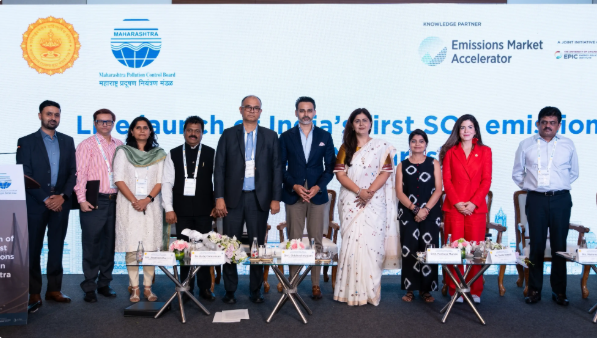
The initiative was announced on November 17, 2026, in Mumbai in the presence of Environment and Climate Change Minister Pankaja Munde. The Maharashtra Pollution Control Board (MPCB) is implementing the initiative in collaboration with the Emissions Market Accelerator (EMA), a partnership involving the Energy Policy Institute at the University of Chicago (EPIC) and the Abdul Latif Jameel Poverty Action Lab (J-PAL).
The newly announced SO2 market introduces a market-based method of controlling industrial emissions. Instead of relying exclusively on conventional pollution-control requirements, the system will allow participating industrial plants to buy and sell emission permits.
The idea is to encourage industries that can reduce their sulphur dioxide emissions at relatively lower costs to make larger reductions. These industries can then sell their unused permits to other participating plants that face higher costs when reducing pollution.
Through this arrangement, the government aims to achieve overall emission reductions while giving industries flexibility in deciding how to meet their obligations.
According to the announcement, approximately 130 million people across Maharashtra are expected to benefit from improved air quality under the statewide initiative.
The announcement marks an important development in Maharashtra’s environmental policy because it expands the use of emissions trading from earlier experiments involving particulate pollution to a statewide sulphur dioxide market.
The SO2 market is also expected to encourage industries to consider cleaner production methods, invest in pollution-control technologies and monitor their emissions more effectively.
The initiative has been developed through years of research, institutional cooperation and regulatory preparation.
It is intended to demonstrate how economic incentives and scientific evidence can work together to address industrial pollution without placing unnecessary financial pressure on businesses.
What Is Sulphur Dioxide and Why Is It Harmful?
Sulphur dioxide, commonly written as SO2, is a colourless gas with a sharp, irritating smell.
It is primarily released through activities involving the burning of sulphur-containing fuels and certain industrial processes.
Power generation, industrial boilers, metal processing, petroleum refining and other industrial activities can contribute to sulphur dioxide emissions.
When sulphur-containing fuels are burned, the sulphur present in the fuel can combine with oxygen and form sulphur dioxide.
Industrial emissions can become a serious environmental concern, particularly in areas where several factories operate close to residential communities.
Exposure to sulphur dioxide can affect the respiratory system. It can irritate the airways and make breathing difficult, especially for people with asthma and other respiratory conditions.
High concentrations can cause significant respiratory discomfort.
Sulphur dioxide also contributes to the formation of secondary air pollutants. In the atmosphere, it can undergo chemical reactions and form sulphate particles, which contribute to fine particulate matter.
These particles can affect air quality and public health.
SO2 can also contribute to acid deposition, which may affect soil, water bodies, vegetation and buildings.
This is why controlling industrial sulphur dioxide emissions is an important part of improving environmental conditions.
Maharashtra’s SO2 market is designed to address this challenge by creating a system in which participating industries have an economic reason to reduce their pollution levels.
Instead of treating emissions only as a regulatory obligation, the scheme introduces a financial incentive for cleaner industrial operations.
The expected environmental benefits will depend on how effectively the emission limits are designed, how accurately pollution is monitored and how consistently participating industries follow the rules.
How Will Maharashtra’s SO2 Market Work?
The most important feature of the SO2 market is the trading of emission permits.
An emissions trading system generally works by establishing a limit on the total pollution that participating industries can collectively release during a specified compliance period.
Permits are then allocated or made available to the participating industries.
Each permit represents an authorised quantity of emissions under the applicable scheme rules.
Industries that reduce their sulphur dioxide emissions below their permitted levels may have surplus permits.
These unused permits can be sold to other participating industries that need additional permits to cover their emissions.
For example, consider two factories participating in the scheme.
Factory A invests in improved pollution-control equipment and reduces its sulphur dioxide emissions substantially.
As a result, it does not need to use all the permits available to it.
Factory B, meanwhile, finds that reducing its emissions immediately would involve higher costs because it needs to upgrade its existing equipment.
Under the trading system, Factory A may be able to sell its surplus permits to Factory B, subject to the scheme’s applicable rules.
Factory B can purchase the permits it needs, while Factory A receives a financial benefit for reducing its pollution.
This arrangement creates an incentive for industries to find cost-effective ways of controlling emissions.
The SO2 market is intended to ensure that industries have flexibility in meeting their environmental obligations while the overall pollution limit remains controlled by the regulator.
However, trading permits does not mean that factories can release unlimited pollution.
Participating plants must comply with the applicable emission limits, monitoring requirements and trading rules established by the authorities.
The effectiveness of the system will depend on proper implementation, accurate measurement and strict enforcement.
Why Is Maharashtra’s SO2 Market Considered a Major Environmental Development?
Maharashtra’s initiative is significant because it introduces India’s first statewide sulphur dioxide emissions trading market.
India has already experimented with market-based approaches to industrial pollution control.
The most notable example is the particulate matter emissions trading programme introduced in Surat, Gujarat, in 2019.
That initiative demonstrated how industries could be encouraged to reduce pollution through a system that combines regulatory limits, emissions monitoring and financial incentives.
Maharashtra’s SO2 market builds on the experience gained from such initiatives but applies the market-based approach to a different pollutant.
Sulphur dioxide is an important industrial air pollutant, and controlling its emissions can contribute to improved air quality.
The statewide nature of the initiative also makes it an important policy development.
The programme is expected to benefit approximately 13 crore people across Maharashtra.
This means that the initiative has implications beyond the industries directly participating in the market.
Industrial pollution can affect neighbouring residential areas, workers, surrounding communities and the wider environment.
A properly designed emissions market can encourage industries to reduce pollution in a way that is economically efficient.
The announcement also reflects the Maharashtra government’s intention to use technology, scientific research and cooperation with industries to improve environmental governance.
The SO2 market could become an important example for other states looking at innovative approaches to industrial pollution management.
However, its long-term success will depend on the results achieved after implementation.
Pankaja Munde Announces the Initiative in Mumbai
The Maharashtra government’s announcement was made on November 17, 2026, during an event in Mumbai attended by Environment and Climate Change Minister Pankaja Munde.
The minister highlighted the growing challenges of pollution as cities expand and industrial activity increases.
She emphasised the importance of using technology, including artificial intelligence, to improve industrial pollution monitoring and make environmental systems more effective.
According to the minister, environmental regulation should not focus only on controlling industries.
Government departments should also work with industrial organisations and encourage participation in developing solutions that support both economic growth and environmental protection.
Her remarks reflected the broader objective behind the SO2 market.
The initiative is designed to create a system in which industries have incentives to reduce pollution while continuing their economic activities.
MPCB Chairman Siddhesh Ramdas Kadam also highlighted the importance of cooperation between the government, industries and research institutions.
He described the initiative as an important achievement for Maharashtra and emphasised that active participation from industries and knowledge partners would be essential for its success.
The programme has been developed through cooperation between the Maharashtra Pollution Control Board, the Emissions Market Accelerator and academic research institutions.
The involvement of research organisations is particularly important because emissions trading systems require detailed technical preparation.
Authorities must determine which industries will participate, how emissions will be measured, how permits will be traded and how compliance will be verified.
The SO2 market therefore represents not only a new environmental policy but also an institutional effort involving government, industry and scientific research.
What Is the Role of Maharashtra Pollution Control Board?
The Maharashtra Pollution Control Board plays a central role in the implementation of the new emissions trading initiative.
The MPCB is responsible for regulating industrial pollution and monitoring compliance with environmental requirements across the state.
Under the SO2 market, the board will work with participating industries and research partners to establish the necessary monitoring and regulatory arrangements.
An emissions trading system requires reliable information about how much pollution each participating factory releases.
Without accurate emissions data, it would be difficult to determine whether industries are complying with their obligations or whether permits are being traded appropriately.
The board’s responsibilities therefore include developing an effective framework for monitoring industrial emissions and ensuring that the market operates according to the applicable rules.
MPCB is also working with academic and technical partners to strengthen environmental enforcement through data-driven approaches.
The announcement included a separate agreement between MPCB and the University of Chicago Trust to develop an AI-assisted inspection framework.
The framework is intended to use data analytics, artificial intelligence and machine learning to help identify industrial facilities that may have a higher probability of non-compliance.
This could help inspectors prioritise their inspections and use available resources more efficiently.
The SO2 market and the proposed AI-assisted inspection system are related developments in Maharashtra’s wider effort to modernise environmental regulation.
Both initiatives highlight the growing importance of technology and reliable information in controlling industrial pollution.
What Is the Emissions Market Accelerator?
The Emissions Market Accelerator, or EMA, is an international partnership that works to expand emissions trading systems as a method of reducing pollution.
It is a collaboration involving the Energy Policy Institute at the University of Chicago and the Abdul Latif Jameel Poverty Action Lab.
The organisation works with governments, regulators and research institutions to develop market-based approaches to environmental challenges.
Its involvement in Maharashtra’s SO2 market builds on earlier experience with emissions trading in India.
EMA supports the development of pollution markets through technical research, regulatory design, emissions monitoring and cooperation with government agencies.
An important part of this work involves ensuring that emission limits and trading rules are designed according to the characteristics of the industries and pollutants involved.
A successful emissions market requires more than simply allowing companies to buy and sell permits.
The total pollution limit must be meaningful, emissions must be measured accurately, and participating companies must be held accountable for meeting their obligations.
The partnership aims to use evidence from previous emissions trading programmes to support Maharashtra’s new initiative.
The involvement of international research institutions also highlights the importance of scientific evidence in environmental policy decisions.
Maharashtra’s SO2 Market Builds on Gujarat’s Surat Experiment
One of the most important foundations for Maharashtra’s new initiative is the emissions trading programme introduced in Surat, Gujarat.
In 2019, the Gujarat Pollution Control Board launched a particulate matter emissions trading system in the industrial city.
The programme was designed to reduce particulate pollution from industrial units by introducing a cap-and-trade mechanism.
Participating industries received emission permits and were required to ensure that their emissions remained within the applicable limits.
Factories that reduced pollution could sell their surplus permits to other participating units.
The Surat experiment became an important example of how market-based mechanisms could be used to address industrial air pollution.
Research associated with the programme found that participating factories reduced particulate matter emissions compared with industries operating under conventional regulation.
The initiative also demonstrated that emissions trading could provide flexibility to industries while encouraging pollution reduction.
Maharashtra’s SO2 market builds on this experience but focuses on sulphur dioxide rather than particulate matter.
The difference is important because each pollutant has different sources, environmental effects and monitoring requirements.
A trading system designed for particulate matter cannot simply be copied without adjustments when applied to sulphur dioxide.
The Maharashtra programme therefore involves additional research and regulatory preparation to establish suitable industry coverage, emissions monitoring and trading rules.
The experience from Gujarat provides a foundation, while the new Maharashtra initiative represents an expansion of India’s use of market-based pollution control.
How Will the SO2 Market Benefit Maharashtra’s Residents?
The government expects approximately 130 million residents to benefit from improved air quality under the statewide initiative.
Industrial pollution can affect people living close to factories and industrial clusters.
Workers, children, elderly people and individuals with respiratory conditions may be particularly vulnerable to poor air quality.
By encouraging industries to reduce sulphur dioxide emissions, the SO2 market aims to address one source of industrial air pollution.
Potential benefits include:
1. Improved Industrial Air Quality
Reducing sulphur dioxide emissions can help improve environmental conditions in industrial areas.
2. Better Respiratory Health Protection
Lower exposure to sulphur dioxide can reduce respiratory irritation and help protect people who are particularly sensitive to air pollution.
3. Reduced Formation of Secondary Particulate Pollution
Sulphur dioxide can contribute to the formation of sulphate particles in the atmosphere. Reducing emissions can help limit this contribution.
4. Stronger Environmental Monitoring
The programme encourages accurate measurement and reporting of industrial emissions.
5. Cleaner Industrial Practices
Industries have an incentive to invest in pollution-control equipment and improve production efficiency.
6. More Cost-Effective Pollution Reduction
Companies can choose the most economical methods of reducing emissions while complying with the overall pollution limit.
7. Greater Cooperation Between Government and Industry
The programme encourages regulators, industrial organisations and research institutions to work together.
The actual benefits of the SO2 market will depend on the scale of implementation and the level of emission reductions achieved.
The projected population benefiting from the initiative represents the intended reach of the programme, not a guarantee that every resident will experience the same improvement in air quality.
How Will Industries Be Affected by the New SO2 Trading Scheme?
The new initiative is expected to change how participating industries approach pollution management.
Under traditional regulatory systems, industries generally have to meet prescribed emission standards and install suitable pollution-control equipment.
The SO2 market adds another economic mechanism to this process.
Industries will have an incentive to identify ways of reducing emissions at lower costs.
A factory that can reduce pollution more efficiently may benefit financially by selling surplus permits.
A factory facing higher immediate reduction costs may purchase permits instead, subject to the applicable limits and regulations.
This flexibility can help reduce the overall cost of achieving a given level of pollution reduction.
It may also encourage industries to evaluate their production processes, fuel use and pollution-control equipment.
Some factories may choose to invest in improved combustion systems, cleaner fuels or suitable emissions-control technology.
Others may focus on improving operational efficiency to reduce the amount of pollution generated during production.
However, the SO2 market does not remove the responsibility of industries to follow environmental laws.
Participating plants must meet the requirements established by MPCB and comply with the market’s monitoring and trading procedures.
The market is designed to complement environmental regulation, not replace it.
What Is the Difference Between SO2 Trading and Carbon Trading?
Many people may confuse the new SO2 market with carbon trading.
Although both systems use emissions permits and market-based mechanisms, they address different environmental problems.
SO2 trading focuses on sulphur dioxide, a pollutant associated with industrial emissions and local or regional air-quality problems.
Carbon trading generally focuses on greenhouse gas emissions, particularly carbon dioxide and other gases that contribute to climate change.
The purpose of carbon markets is to limit greenhouse gas emissions and support climate-related targets.
The purpose of the Maharashtra SO2 initiative is to reduce industrial sulphur dioxide pollution and improve air quality.
Both approaches can use a cap-and-trade structure.
However, the pollutants covered, measurement methods, environmental objectives and regulatory requirements are different.
The SO2 market is therefore an air-pollution control initiative rather than a conventional carbon market.
Understanding this distinction is important when discussing Maharashtra’s latest environmental announcement.
Maharashtra Also Introduces AI-Based Industrial Pollution Monitoring Plans
Alongside the announcement of the SO2 market, Maharashtra has taken another step towards strengthening environmental monitoring through artificial intelligence.
The Maharashtra Pollution Control Board and the University of Chicago Trust have signed a separate Memorandum of Understanding to advance data-driven environmental regulation.
Under the agreement, the institutions will jointly develop and pilot an AI-assisted inspection framework.
The proposed system will use data shared by MPCB to help identify industrial facilities with a higher likelihood of non-compliance.
The purpose is to support inspectors in identifying where additional attention may be required.
Artificial intelligence and machine learning can help analyse large amounts of information and identify patterns that may be difficult to detect through manual processes alone.
The partnership will also include knowledge-sharing and technical training for MPCB officers and inspectors.
The training will focus on artificial intelligence, environmental data analytics and the use of technology in regulatory work.
Evidence collected through the pilot will help authorities assess whether the framework can be expanded across Maharashtra.
This development complements the broader environmental objectives of the SO2 market by improving the state’s ability to monitor industrial activities and identify potential violations.
However, the AI-assisted inspection framework is a separate initiative and should not be confused with the actual permit-trading mechanism.
What Challenges Could Maharashtra Face While Implementing the SO2 Market?
Although the new initiative offers an innovative approach to industrial pollution control, its success will depend on effective implementation.
An emissions trading system requires strong monitoring, transparent rules and reliable enforcement.
Some of the important challenges include:
1. Accurate Measurement of Emissions
Industries must have reliable systems for measuring sulphur dioxide emissions.
Incorrect or incomplete data could affect the credibility of the trading system.
2. Effective Monitoring
Authorities need to ensure that participating industries report accurate information and follow the applicable requirements.
3. Transparent Permit Trading
The rules governing the allocation, purchase and sale of permits must be clear and transparent.
4. Appropriate Emission Limits
The overall pollution cap must be designed carefully to ensure that the system delivers meaningful environmental improvements.
5. Industry Participation
Industries need to understand the scheme and actively participate in the required monitoring and compliance arrangements.
6. Enforcement Against Violations
Authorities must have the capacity to identify and address non-compliance.
7. Long-Term Environmental Results
The programme must be evaluated over time to determine whether reductions in industrial emissions are translating into improved air quality for surrounding communities.
The SO2 market will therefore require continuous evaluation rather than relying only on the announcement of the initiative.
Transparent information about participating industries, emission reductions and compliance performance will be important in assessing its success.
Seven Important Things to Know About Maharashtra’s SO2 Market
Here are seven important facts about the newly announced initiative:
- India’s first: Maharashtra has announced India’s first statewide sulphur dioxide emissions trading market.
- Announcement date: The initiative was announced in Mumbai on November 17, 2026.
- Government leadership: Environment and Climate Change Minister Pankaja Munde attended the announcement.
- Implementing authority: The Maharashtra Pollution Control Board is working with the Emissions Market Accelerator.
- Population reach: Approximately 13 crore residents are expected to benefit from improved air quality.
- Trading mechanism: Participating plants will be able to buy and sell emission permits under the scheme’s rules.
- Technology support: Maharashtra is also developing an AI-assisted inspection framework to strengthen environmental enforcement.
Frequently Asked Questions About the SO2 Market
1. What is the SO2 market announced by Maharashtra?
It is a sulphur dioxide emissions trading system that allows participating industrial plants to buy and sell emission permits to encourage cost-effective pollution reduction.
2. Is Maharashtra the first state in India to introduce this system?
Yes. The November 17, 2026 announcement describes it as India’s first statewide sulphur dioxide pollution market.
3. Who is implementing the initiative?
The Maharashtra Pollution Control Board is implementing it in collaboration with the Emissions Market Accelerator, which involves EPIC at the University of Chicago and J-PAL.
4. What is the main objective of the SO2 market?
Its objective is to reduce industrial sulphur dioxide emissions and improve air quality through a market-based regulatory mechanism.
5. How many people are expected to benefit?
Approximately 130 million people across Maharashtra are expected to benefit from improved air quality.
6. What are emission permits?
Emission permits represent an authorised quantity of emissions under the applicable trading scheme. Participating plants can trade surplus permits according to the established rules.
7. Is the SO2 market the same as carbon trading?
No. The SO2 market focuses on sulphur dioxide pollution, whereas carbon trading generally focuses on greenhouse gas emissions.
8. When did Maharashtra begin preparing for the initiative?
MPCB launched mock trading for the sulphur dioxide emissions market on April 22, 2026, before the statewide announcement on November 17, 2026.
9. What is the role of artificial intelligence?
AI is being explored separately to help MPCB identify industrial facilities with a higher likelihood of non-compliance and improve inspection planning.
10. Will the initiative eliminate industrial pollution?
No. The scheme is designed to reduce sulphur dioxide emissions. Its effectiveness will depend on implementation, monitoring, compliance and enforcement.
Conclusion: Maharashtra Takes a New Step Towards Cleaner Industrial Air
Maharashtra’s announcement of India’s first statewide sulphur dioxide emissions trading market marks an important development in the state’s environmental policy. By allowing participating industrial plants to trade emission permits, the government aims to encourage pollution reduction while giving industries greater flexibility in meeting environmental requirements.
The initiative, announced in Mumbai on November 17, 2026, is being implemented by the Maharashtra Pollution Control Board in collaboration with the Emissions Market Accelerator. With approximately 13 crore residents expected to benefit from improved air quality, the programme has the potential to influence how industrial pollution is managed across the state.
Its success will depend on accurate emissions measurement, transparent permit trading, effective monitoring and strict enforcement. The separate introduction of AI-assisted inspection plans also highlights Maharashtra’s growing focus on technology-driven environmental governance.
The SO2 market will now be an important initiative to watch as the state works towards balancing industrial development with cleaner air and environmental protection.
Stay Updated With Police Vartha
Follow POLICE VARTHA for the latest Maharashtra news, environmental updates, government announcements, industrial developments and breaking news from across India.
We bring you important updates covering public issues, pollution, government policies, local developments, crime and major national events.
WANT TO SHARE NEWS OR PROMOTE YOUR BUSINESS?
Connect with Police Vartha for:
- News Coverage & Publicity
- Business & Brand Advertising
- Local News & Event Coverage
Contact us for news coverage and advertising enquiries.