

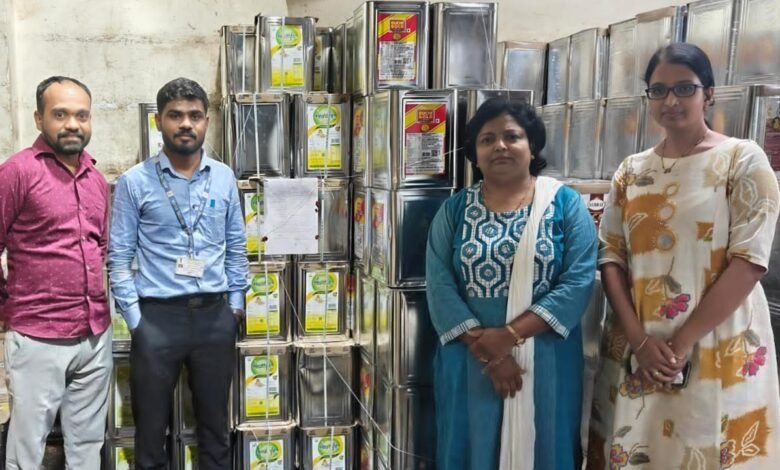
Pune Oil Seizure: 7 Alarming Facts About FDA’s ₹50.27 Lakh Action
The seized stock was found at an Avenue Supermarts warehouse in Maval, with officials collecting nine samples for laboratory examination. The investigation will determine whether the products complied with food quality and labelling regulations.


Pune Oil Seizure: 20,085 Litres of Edible Oil Worth ₹50.27 Lakh Confiscated by FDA
A major food safety enforcement operation in Pune has brought 20,085 litres of edible oil under the scanner after Maharashtra’s Food and Drug Administration seized the stock from an Avenue Supermarts Limited warehouse in Maval. The seized products, valued at approximately ₹50.27 lakh, are suspected of violating prescribed quality standards and misbranding regulations. Samples have been sent for laboratory testing, with further legal action expected after the results are received.
Pune Oil Seizure: FDA Confiscates 20,085 Litres of Edible Oil in Maval
The Maharashtra Food and Drug Administration (FDA) has seized a massive stock of 20,085 litres of edible oil worth ₹50.27 lakh from a warehouse operated by Avenue Supermarts Limited in Pune district.
The enforcement operation was conducted on November 17, 2026, at a facility located in Ambi village, Maval taluka.
According to reports, the department suspected that the edible oil stock did not meet the prescribed quality standards and involved violations relating to misbranding under food safety regulations.
The officials took possession of the entire identified stock at the warehouse as part of the enforcement action.
The Pune Oil Seizure has drawn attention because of the large quantity of edible oil involved and the fact that the operation was conducted at a facility belonging to Avenue Supermarts Limited, the company associated with the D-Mart retail chain.
During the inspection, food safety officials collected nine samples of different edible oil products for laboratory examination.
The samples included refined sunflower oil, rice bran oil, mustard oil and groundnut oil sold under different brands.
The collected samples have been forwarded to a laboratory for analysis to determine whether the products comply with the applicable food safety and quality requirements.
Officials have indicated that further proceedings will be initiated under the law after the laboratory results are received.
The Pune Oil Seizure is part of Maharashtra’s wider enforcement efforts to monitor food quality, prevent the distribution of non-compliant products and ensure that food businesses follow the provisions of the Food Safety and Standards Act.
The development has also raised questions about the importance of quality checks, proper product labelling, storage procedures and regulatory inspections in the edible oil supply chain.
However, it is important to note that the laboratory results are awaited. The seizure itself does not establish that every product in the stock was adulterated or unsafe for consumption.
Where Did the FDA Conduct the Pune Oil Seizure Operation?
The operation took place at an Avenue Supermarts Limited facility situated at Gat No. 113, Shed No. 1, Ambi village, in Maval taluka of Pune district.
The location was inspected by the Pune Division-10 team of the Food and Drug Administration.
During the inspection, officials identified a stock of 20,085 litres of edible oil that was suspected of violating prescribed food quality and branding requirements.
The department subsequently took possession of the stock valued at ₹50,27,893.
The location is significant because warehouses and distribution facilities play an important role in the movement of packaged food products between manufacturers, distributors and retail outlets.
A large quantity of edible oil stored at a distribution facility may eventually move through different stages of the supply chain before reaching consumers.
Regulatory inspections at such locations are therefore important for identifying potential non-compliance before products are distributed further.
The Pune Oil Seizure demonstrates the role of food safety authorities in inspecting not only manufacturing units and retail establishments but also storage and distribution facilities.
The authorities have not established through laboratory results that all the seized products were defective. The samples must first undergo the prescribed testing process.
The final findings will help determine whether the products met the required standards and what further action may be necessary.
Which Edible Oil Products Were Included in the Inspection?
During the operation, officials collected nine samples representing different edible oil products and packaging variants.
The products included:
- Refined sunflower oil sold under the Aadhar brand.
- Physically refined rice bran oil sold under the Fortune brand.
- Kachi Ghani mustard oil sold under the Patanjali brand.
- Cold-pressed mustard oil sold under the Saffola brand.
- Peanut oil sold under the Saffola brand.
- Different packaging variants of the sampled products, including pouches, bottles and jars.
The samples were collected to examine whether the products complied with the applicable food quality standards and labelling requirements.
It is important to understand that the collection of samples does not mean that every product or brand mentioned has been declared unsafe or adulterated.
The laboratory examination is intended to establish whether the samples meet the relevant specifications.
The Pune Oil Seizure has attracted attention because several familiar edible oil brands were represented among the samples collected by the authorities.
However, consumers should avoid drawing conclusions about individual brands until the official laboratory findings and any subsequent regulatory orders are available.
Food safety investigations require scientific examination of the collected samples rather than assumptions based only on the fact that products were present in a seized stock.
The results will be important in determining the next steps in the case.
Why Did Maharashtra FDA Seize the Edible Oil Stock?
The FDA’s action was based on suspected violations involving quality standards and misbranding provisions under food safety laws.
Food products sold in India must comply with requirements governing their composition, quality, labelling, packaging and other applicable standards.
Edible oils are widely consumed in households, restaurants, food processing units and commercial kitchens.
Because they are an essential part of everyday food preparation, maintaining their quality and ensuring accurate product information are important public health responsibilities.
A product may attract regulatory scrutiny if it does not comply with prescribed standards or if its labelling does not accurately represent the product.
Misbranding is a food law concern that can involve misleading or non-compliant information about a food product.
Similarly, a product suspected of being substandard may require laboratory examination to determine whether its actual characteristics meet the applicable specifications.
In the present Pune Oil Seizure, the authorities took possession of the stock while samples were collected for further examination.
The laboratory findings will help establish whether the products violated the applicable requirements.
If violations are confirmed, the department can consider further action under the relevant provisions of food safety legislation.
Until then, the correct description is suspected substandard and misbranded edible oil, rather than confirmed adulterated oil.
What Happens to the Seized Oil After the FDA Operation?
After identifying the suspected stock, the FDA took possession of the 20,085 litres of edible oil.
The department also collected nine samples representing different products and packaging variants.
These samples were sent to a laboratory for scientific analysis.
Laboratory testing is an important stage in food safety investigations because it provides objective information about the composition and quality of the products.
Officials can use the findings to determine whether the products comply with the applicable standards.
The process generally involves several important stages.
1. Identification of the Suspected Products
Food safety officials inspect the premises and identify products that may require further examination.
2. Collection of Samples
Samples are collected from the relevant products following the applicable sampling procedures.
3. Laboratory Examination
The collected samples are examined to determine whether they meet the required food quality specifications.
4. Evaluation of Laboratory Findings
The department reviews the results to determine whether any regulatory violation has been established.
5. Further Legal Proceedings
If violations are confirmed, the authorities can initiate appropriate proceedings under the applicable provisions of food safety legislation.
The Pune Oil Seizure has reached the stage where the samples have been forwarded for laboratory examination.
The next major development will depend on the findings received by the department.
The FDA has indicated that proceedings under the law will follow after the laboratory results are available.
Which Officials Led the Pune FDA Operation?
The operation was carried out by the Maharashtra Food and Drug Administration’s Pune Division-10 team.
The action was conducted under the guidance of FDA Vigilance Joint Commissioner Preeti Tipare and Pune Division Joint Commissioner (Food) Shrikant Karakale.
Assistant Commissioner DS Salunkhe led the enforcement team.
The team also included Food Safety Officers AB Bhise and SS Hake.
Food Safety Officer Balaji Shinde from the Pune Intelligence Bureau provided intelligence inputs for the operation.
The involvement of different officials highlights the coordination required for large-scale food safety enforcement operations.
Intelligence inputs can help authorities identify locations requiring inspection and focus their resources on suspected violations.
The Pune Oil Seizure also demonstrates the importance of coordination between vigilance officials, food safety officers and intelligence teams when inspecting large storage facilities.
The department’s action was directed towards identifying potential violations and securing the suspected stock while the samples undergo laboratory examination.
What Is the Food Safety and Standards Act, 2006?
The Food Safety and Standards Act, 2006, is the primary legislation governing food safety in India.
It establishes a framework for regulating the manufacture, storage, distribution, sale and import of food products.
The main objective is to ensure that food items available to consumers meet prescribed safety and quality requirements.
The legislation also provides a regulatory framework for licensing food businesses, inspections, sampling, laboratory analysis and enforcement action.
The Food Safety and Standards Authority of India (FSSAI) is the national authority responsible for establishing science-based standards and regulating food safety at the national level.
State food safety departments, including Maharashtra’s FDA, carry out enforcement and inspection activities within their respective jurisdictions.
The Pune Oil Seizure is an example of state-level enforcement under the broader food safety regulatory framework.
Food businesses are expected to comply with the applicable requirements relating to food quality, hygiene, packaging and labelling.
When officials identify suspected violations, they may take action in accordance with the powers and procedures established under the legislation.
The objective is to protect consumers and ensure that food businesses operate according to the prescribed standards.
Why Is Edible Oil Quality Important for Consumers?
Edible oil is one of the most commonly used ingredients in Indian households.
It is used for frying, cooking, preparing traditional dishes and manufacturing several packaged food products.
Because edible oil is consumed regularly, maintaining its quality is important for consumers.
The quality of an edible oil product can depend on several factors, including its source, processing method, composition, storage conditions and packaging.
Consumers generally rely on the product label and the reputation of the manufacturer when choosing packaged edible oils.
However, regulatory quality checks are also necessary to ensure that products available in the market meet the required standards.
The Pune Oil Seizure has brought attention to the importance of these checks, particularly when large quantities of products are stored at distribution facilities.
Consumers should pay attention to several basic details when purchasing packaged edible oil.
Check the Manufacturing and Expiry Information
Always examine the manufacturing date, best-before information and other details printed on the packaging.
Read the Product Label
Check the name of the oil, declared ingredients, net quantity and other mandatory information.
Look for Packaging Damage
Avoid purchasing products with damaged, leaking, tampered or improperly sealed packaging.
Purchase From Reliable Sellers
Buy edible oil from established retailers and authorised sellers.
Retain the Purchase Receipt
Keeping a bill or purchase receipt can help consumers raise a complaint if a product-related issue is identified.
These precautions do not replace regulatory testing, but they can help consumers make more informed purchasing decisions.
What Is Misbranding in Food Products?
Misbranding is an important concept under India’s food safety regulations.
It generally refers to food products whose labelling, presentation or other representations do not comply with applicable legal requirements or may mislead consumers.
Food labels are intended to provide essential information about the product.
This can include its identity, ingredients, quantity, manufacturer details and other declarations required under the relevant regulations.
Accurate labelling helps consumers understand what they are purchasing.
It also allows regulatory authorities to identify products and examine whether the information provided is compliant.
In the context of the Pune Oil Seizure, misbranding was one of the suspected violations cited by the authorities.
However, the exact nature of the alleged labelling violations should not be assumed without the department’s detailed findings.
The laboratory examination and subsequent regulatory assessment will help determine the appropriate course of action.
What Is the Difference Between Substandard and Adulterated Food?
The terms substandard and adulterated are sometimes used interchangeably in everyday conversations, but they have different meanings under food safety law.
A substandard food product is one that does not meet the prescribed quality standards, while adulteration generally involves the presence of an unwanted or prohibited substance, or other forms of contamination or alteration as defined under applicable law.
A product may be classified as substandard without necessarily being established as adulterated.
Similarly, a suspected product must be examined before a final regulatory conclusion is reached.
This distinction is particularly important in reporting the Pune Oil Seizure.
The FDA’s action involved suspicion of substandard and misbranded edible oil.
The department collected samples and sent them for laboratory analysis.
Until the findings are available, it would be inaccurate to state that all 20,085 litres were conclusively adulterated.
Responsible reporting requires a clear distinction between allegations, suspected violations and confirmed findings.
Will the Pune Oil Seizure Affect Consumers?
The seizure has raised public interest because edible oil is an essential household product and the stock involved was substantial.
However, the available information does not establish that the seized stock had already reached consumers through retail outlets.
The operation took place at a warehouse facility in Ambi village, Maval taluka.
The department took possession of the identified stock and collected samples for laboratory testing.
The Pune Oil Seizure should therefore be understood as a regulatory enforcement action involving suspected non-compliant stock at a storage facility.
The laboratory results will be important in determining whether the products met the required standards.
Consumers should not assume that all products belonging to the brands represented in the samples are unsafe.
The investigation relates to the specific stock and samples examined by the authorities.
Any wider regulatory action would depend on the evidence and findings obtained during the investigation.
What Can Consumers Do If They Suspect an Edible Oil Product Is Unsafe?
Consumers who notice unusual packaging, misleading labels, damaged seals or other concerns about a food product can raise the issue with the appropriate authorities.
The following steps may help:
- Preserve the original packaging and purchase bill.
- Take photographs of the product label, batch number and packaging.
- Avoid consuming a product if there is a reasonable concern about its condition.
- Contact the seller or manufacturer to report the issue.
- Submit a complaint through the appropriate food safety grievance channels.
- Provide the product details and supporting evidence when making a complaint.
Consumers can also refer to the official FSSAI website for information about food safety standards and complaint mechanisms.
The Pune Oil Seizure highlights why public awareness and regulatory monitoring are both important for maintaining food quality.
Food safety is a shared responsibility involving manufacturers, distributors, retailers, regulators and consumers.
Seven Important Facts About the Pune Oil Seizure
Here are seven key details about the FDA’s operation:
- Quantity seized: 20,085 litres of edible oil.
- Estimated value: ₹50,27,893, approximately ₹50.27 lakh.
- Company involved: Avenue Supermarts Limited.
- Location: Ambi village, Maval taluka, Pune district.
- Date of operation: November 17, 2026.
- Samples collected: Nine samples representing different edible oil products and packaging variants.
- Current status: Samples sent for laboratory examination; further legal proceedings are expected after the results.
The Pune Oil Seizure is an important reminder of the role of food safety inspections in monitoring large food storage and distribution facilities.
Frequently Asked Questions About the Pune Oil Seizure
1. How much edible oil did the FDA seize in Pune?
The Maharashtra FDA seized 20,085 litres of edible oil from an Avenue Supermarts Limited facility in Pune district.
2. What is the value of the seized oil?
The seized stock was valued at ₹50,27,893, approximately ₹50.27 lakh.
3. Where did the operation take place?
The operation was conducted at Gat No. 113, Shed No. 1, Ambi village, Maval taluka, Pune district.
4. When was the Pune Oil Seizure conducted?
The FDA operation took place on November 17, 2026.
5. Why did the FDA seize the oil?
The stock was suspected of violating prescribed quality standards and misbranding provisions under food safety regulations.
6. Which company operated the facility?
The facility belonged to Avenue Supermarts Limited, the company associated with the D-Mart retail chain.
7. Which oil products were sampled?
The samples included sunflower oil, rice bran oil, mustard oil and peanut oil sold under different brands.
8. Have the laboratory results been announced?
The available reports state that the samples were sent for laboratory analysis. A confirmed result has not been established in the information currently available.
9. Does the seizure mean all the brands involved are unsafe?
No. The seizure does not establish that every product or brand represented in the samples is unsafe. The findings must be assessed through the prescribed testing and regulatory process.
10. What will happen next?
The FDA is expected to review the laboratory findings and initiate appropriate legal proceedings if violations are established.
Conclusion: Major Food Safety Action in Pune Raises Questions About Edible Oil Quality
The seizure of 20,085 litres of edible oil worth ₹50.27 lakh from an Avenue Supermarts Limited facility in Maval marks a significant food safety enforcement action by Maharashtra’s Food and Drug Administration.
The operation, conducted on November 17, 2026, focused on suspected violations involving product quality standards and misbranding. Nine samples representing different edible oil products were collected and sent for laboratory examination. The findings will determine whether the stock violated the applicable food safety requirements and what further action should follow.
The Pune Oil Seizure also highlights the importance of regulatory inspections at warehouses and distribution facilities, where large quantities of food products are stored before reaching the market. While the operation has raised concerns about edible oil quality, consumers should wait for the official laboratory findings before drawing conclusions about the products or brands involved.
Strong monitoring, transparent investigations and strict compliance with food safety laws remain essential to protecting consumers across Maharashtra.
Stay Updated With Police Vartha
Follow POLICE VARTHA for the latest Pune news, Maharashtra FDA updates, food safety alerts, consumer awareness stories and breaking news from across India.
We bring you important updates covering public safety, government action, consumer rights, crime, local developments and major national events.
WANT TO SHARE NEWS OR PROMOTE YOUR BUSINESS?
Connect with Police Vartha for:
- News Coverage & Publicity
- Business & Brand Advertising
- Local News & Event Coverage
Contact us for news coverage and advertising enquiries.